Mind-Bogglingly Crazy: Europe's Heatwave Is Not Weather. It's a Warning.
Ground View News | Continental View
28 May 2026
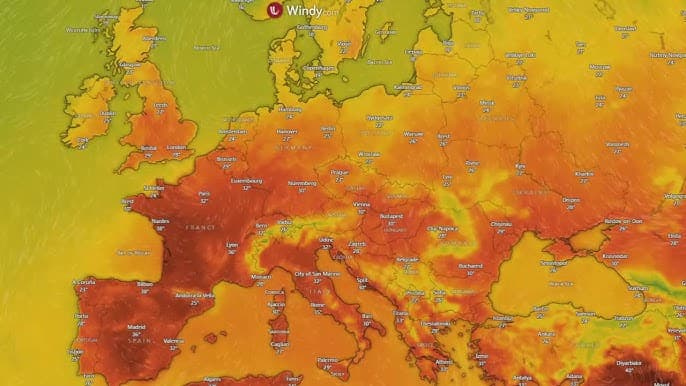
On the morning of 26 May 2026, a temperature of 35.1 degrees Celsius was recorded at Kew Gardens in London breaking the previous record set only the day before by nearly half a degree.1 The average high temperature for London in late May is approximately 20 degrees Celsius.2 That is not a marginal deviation. It is a 15-degree departure from normal in May in Britain.
In France, the temperature approached 37 degrees Celsius. In Spain, it surpassed 38.3 Seven people died in France, including individuals who were taking part in outdoor sporting events.4 Wildfires broke out near Arthur's Seat in Edinburgh.5 Hundreds of properties in southeast England lost water supply as demand overwhelmed infrastructure.6 Overnight temperatures in London did not fall below 21 degrees a phenomenon meteorologists call a "tropical night" and that Britain's housing stock, built for a different climate, is entirely unequipped to manage.7
Peter Thorne, director of the ICARUS Climate Research Centre at Maynooth University in Ireland, was direct in his assessment: "We know beyond a shadow of a doubt that heat wave events such as this have been made more likely and more severe due to climate change arising from our emissions of heat-trapping greenhouse gases. Nevertheless, many of the records being set, particularly in the UK and France, are mind-bogglingly crazy."8
That phrase mind-bogglingly crazy does not come from a climate activist or a politician. It comes from a scientist describing, with calibrated alarm, something that his models and data tell him should not be happening in May.
A One-in-a-Thousand Event
Climate scientist Christophe Cassou, speaking to the French newspaper Le Monde, described the event with similar precision: "This is an unprecedented event with a one in 1,000 chance of happening at this time of year in the climate of 1979 to 2025."9
The phrase "1979 to 2025" carries real weight. It means: measured against nearly five decades of recorded European climate data, a May heatwave of this magnitude had a 0.1 per cent probability of occurring in any given year. It is now occurring. And this is not the first time in recent years that a "one-in-a-thousand" or "once in a generation" weather event has arrived ahead of schedule and at greater intensity than models projected.
2025 was already Europe's hottest year on record. The European Union's Earth observation programme, Copernicus, has documented that Europe is heating at roughly twice the global average approximately 2.5 degrees Celsius above pre-industrial levels.10 The underlying mechanisms are understood: Europe's proximity to the Arctic, the world's fastest-heating region; the loss of glacial and snow cover that previously reflected solar radiation; and changes in atmospheric circulation patterns, including the weakening of the Gulf Stream system, which is intensifying heatwave events and making them more persistent.11
A heat dome of hot air from North Africa is what triggered this particular event hot air pushed northward over the continent, trapping heat across France, Spain, and the British Isles in conditions that are becoming structurally more frequent as the baseline temperature rises.12
What Infrastructure Was Not Built For
There is a particular cruelty to how heatwaves hit northern European countries. In France, Spain, and Italy, there is a cultural and architectural vocabulary for summer heat. In Britain and Ireland, there is almost none.
Only around 5 per cent of UK homes have air conditioning.13 British housing stock the Victorian terraces, the postwar estates, the modern flats built to retain heat performs precisely as designed in a heatwave: it absorbs warmth during the day and does not release it at night. The result is that sustained heat events are more dangerous in Britain than in countries where the same temperature would be considered unremarkable.
The UK's Climate Change Committee, in a report published the week of the heatwave, warned explicitly that the country was unprepared for the heat events that the existing climate trajectory will now deliver with regularity.14 The timing was not coincidental the report had been in preparation for months. But the political will to act on its findings has consistently lagged the speed of the crisis it describes.
Train lines buckled. Underground carriages in London reached temperatures that workplace health and safety legislation would not permit in an office building. The National Health Service issued emergency guidance. These are not fringe consequences. They are the predictable, documented result of an infrastructure built for a climate that no longer exists.
Europe Is Not Alone
While the European heatwave dominated headlines, dangerous early summer heat was simultaneously spreading across large parts of the Northern Hemisphere. India's summer monsoon is predicted to deliver below-average rainfall in 2026, in part due to a developing El Niño, placing hundreds of millions of people in the path of compounding heat and water stress.15 In Kingston, Jamaica, the overnight minimum temperature on 26 May was 28.7 degrees Celsius the hottest daily low on record for that date.16
This is the context that tends to be lost when the European heatwave becomes a story about train delays and ice cream shortages. The same atmospheric conditions driving exceptional heat in London and Paris are part of a broader global pattern. The regional manifestations differ. The underlying cause is shared.
The Political Accountability Gap
Every major European government has made formal climate commitments. Every major European government is now being asked to explain why those commitments have not produced the adaptation infrastructure that a warming Europe requires.
The UK government received warnings about heat preparedness. Ireland received warnings. France had implemented some cooling infrastructure after 2003 when a summer heatwave killed an estimated 15,000 people but the pace of adaptation has not matched the pace of change.17
The standard political response to extreme weather events follows a recognisable sequence: emergency measures, expressions of concern, a commission of inquiry, a report, and a return to business as usual until the next event arrives. The problem with that sequence, in a climate context, is that the events are no longer exceptional. They are becoming the baseline.
A one-in-a-thousand event that arrives as predicted by models, in a year following the hottest year on record, in a region heating twice as fast as the global average, is not bad luck. It is a policy failure dressed as a natural disaster.
The science is not uncertain. The warnings are not new. What is missing is the urgency that matches the scale of what is now occurring every spring.
Continental View publishes independent commentary and analysis on global affairs. This article draws on reporting from NPR, CNN, Scientific American, Yale Climate Connections, and The Weather Network, alongside scientific commentary from researchers at the ICARUS Climate Research Centre and France's National Centre of Scientific Research.
Footnotes
-
The Weather Network, "Deadly, record-breaking heat wave hits Europe. Is it a warning?" 26 May 2026. ↩
-
CNN, "'Mind-bogglingly crazy': Europe's deadly, early heatwave is smashing records," 26 May 2026. ↩
-
Scientific American, "Why a 'heat dome' over Europe is shattering temperature records right now," 26 May 2026. ↩
-
NPR, "A record-breaking heat wave is hitting Europe," 27 May 2026. ↩
-
CNN, op. cit. ↩
-
Ibid. ↩
-
Ibid. ↩
-
NPR, "An exceptionally early heat wave shatters records and brings deaths in Europe," 26 May 2026. Statement attributed to Peter Thorne, ICARUS Climate Research Centre, Maynooth University. ↩
-
Yale Climate Connections, "Western Europe is roasting in unprecedented spring heat and it's not alone," 27 May 2026. Statement attributed to Christophe Cassou, speaking to Le Monde. ↩
-
NPR, "A record-breaking heat wave is hitting Europe," 27 May 2026. ↩
-
Ibid. ↩
-
Ibid. ↩
-
CNN, op. cit. ↩
-
CNN, op. cit. ↩
-
Yale Climate Connections, op. cit. ↩
-
Ibid. ↩
-
NPR, op. cit. ↩
By Ground View News | Continental View
Shared 0 times
Editorial note: This article represents the opinion and analysis of the author and does not constitute verified fact. Ground View News strives for accuracy and publishes corrections when errors are identified. View our editorial policy · Editorial disclaimer