How a Zimbabwean Businessman Just Landed a Piece of Kenya's $2.9 Billion Airport Deal - and What It Means for African Business
Chivayo: The Man Behind IMC Construction Kenya
Chrispen Nkosi, Continental View | Ground View News
17 June 2026
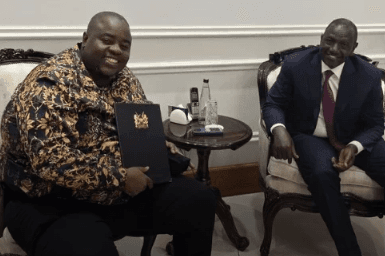
Wicknell Chivayo is not the kind of man who moves quietly. Known across Zimbabwe for a lifestyle as conspicuous as his legal controversies, the 45-year-old businessman has now planted his name at the centre of one of Africa's most closely watched infrastructure projects: the $2.9 billion expansion of Jomo Kenyatta International Airport in Nairobi.
His company, IMC Construction Kenya, has been brought in as a joint venture partner to a consortium led by China Communications Construction Company (CCCC), one of the largest state-owned engineering firms in the world, alongside its subsidiary China Road and Bridge Corporation (CRBC). The consortium was awarded the tender following a competitive bidding process, after the previous contract, granted to India's Adani Group in 2024, was cancelled following opposition from Kenyan labour unions and concerns connected to a corruption investigation in the United States.
The news, confirmed by ZimLive and reported by the Standard and Kenya Times, landed in Nairobi like a stone in still water.
The Deal: What It Is and Why It Matters
Kenya awarded the contract for the upgrade and expansion of JKIA under the newly established National Infrastructure Fund (NIF), with seed capital drawn from the privatisation of the Kenya Pipeline Company. The project is substantial by any standard.
JKIA currently handles nearly 8.8 million passengers annually, already above its original design capacity of eight million. A new runway, planned for completion by 2029, will lift airfield capacity from 14 to 63 aircraft movements per hour. A new passenger terminal is also included in the scope.
Kenya is expected to contribute $1.3 billion towards the project, with the remainder expected to come from local and Chinese financial institutions. Additional financing will come via commercial loans secured against future passenger service charges.
The project forms part of JKIA's 20-year master plan extending to 2045, which outlines phased expansion of airport facilities, investment requirements, and long-term financial projections.
For Kenya, this is not just infrastructure. JKIA is the country's primary gateway to the world. It connects East Africa's largest economy to global trade, tourism, and investment flows. Ethiopia is advancing Bishoftu International Airport, while Rwanda continues work on Bugesera International Airport. Kenya views the JKIA modernisation programme as essential to retaining its hub status within East Africa. A failure to modernise now would mean ceding that position over the next decade.
Chivayo: The Man Behind IMC Construction Kenya
To understand the reaction this deal has provoked, you need to understand who Wicknell Chivayo is.
Chivayo began his working life at the age of 15 and built a business empire that spans energy, construction, and infrastructure across Southern and East Africa. His companies in Zimbabwe have won contracts worth nearly $1 billion, among them $173 million for a solar power plant in Gwanda and $163 million to revamp Munyati Power Station.
His expansion into Kenya has been deliberate and visible. In March 2025, his company Intratrek Zimbabwe signed a $2.5 billion agreement with China's Chint Group for energy transmission projects in Kenya and Tanzania, one of the largest private energy investment deals announced in the region.
The JKIA stake, confirmed by two people familiar with the deal, marks another significant step. IMC Construction Kenya joined CCCC and CRBC as a joint venture partner on the project. CCCC itself is no minor contractor. CCCC and its subsidiary CRBC have previously built the Mombasa-Nairobi Standard Gauge Railway, the Nairobi Expressway, and the 60,000-seat Talanta Stadium. The firm also broke ground in March 2026 on the KSh 549 billion Naivasha–Kisumu–Malaba SGR extension.
Being brought into a consortium of that scale is a commercially significant positioning. It signals that Chivayo has managed to align himself with partners capable of executing at the highest level of African infrastructure delivery.
The Politics Are Unavoidable
The deal cannot be read without reading the relationship.
Chivayo first publicly highlighted his connection with Kenyan President William Ruto in January 2025 when he shared photographs from the President's residence in Kilgoris. He described Ruto as a father and mentor whose guidance extended into matters of faith and personal life, not just business. In January 2026, he met Ruto and Deputy President Kithure Kindiki at Sagana State Lodge. On June 1, 2026, he visited the newly built Wajir State Lodge, disclosing that he was in discussions with Ruto about multimillion-dollar investment projects.
Then, just hours before departing for the G7 Summit in France on June 16, 2026, President Ruto hosted Chivayo at State House, Nairobi. The timing, coming immediately after the JKIA award was reported, was not lost on observers.
That proximity is at the heart of the public concern. The issue is not simply that a Zimbabwean businessman secured a stake in a Kenyan tender. The issue is that the same businessman has made a public performance of his closeness to the head of state, and the award of a major contract followed.
Chivayo's legal history in Zimbabwe adds another layer. His business career has been consistently accompanied by allegations of fraud and irregular procurement. His lawyers have consistently denied the allegations against him.
Civil society groups and opposition politicians in Kenya have called for greater transparency. The echoes of the Adani controversy, which ended in cancelled contracts and street protests, are clearly audible.
What Kenyan Businesses Are Saying
The anger among some Kenyan business communities is not difficult to understand.
Chinese contractors already play a dominant role in Kenya's infrastructure sector, having delivered projects such as the Nairobi Expressway, the Standard Gauge Railway, and the ongoing Rironi–Mau Summit highway expansion. The pattern is established: when Kenya's government goes to the market for large-scale infrastructure, the contracts tend to flow to Chinese state firms with foreign partners. Local Kenyan construction companies rarely feature in the headline awards.
The JKIA expansion reinforces that pattern. The joint venture at the centre of it includes a Chinese state giant, its subsidiary, and a Zimbabwean businessman with no visible primary role for Kenyan firms. For contractors and infrastructure businesses in Nairobi that had been watching this project for years, hoping to participate in a deal of this scale, the outcome is a familiar disappointment.
There is also a matter of precedent. Kenya's procurement framework includes provisions for local content and participation. The question being raised in business and civil society circles is whether those provisions carry any real weight in awards of this magnitude, or whether they are routinely set aside when state-level relationships are at play.
The frustration is commercially legitimate. A $2.9 billion project generates not just construction revenue but a long chain of subcontracting, professional services, engineering, logistics, and supply work. If local firms are not positioned within the primary consortium, they will compete for margins at the edges if they participate at all.
The Implications for Kenya
For Kenya, the broader picture is more complicated than the controversy suggests.
The country needs this project. JKIA is overloaded. The expansion is expected to transform JKIA into one of Africa's leading aviation hubs. Without it, Kenya risks losing its competitive position as East Africa's primary commercial and travel gateway to cities that are investing aggressively in their own aviation infrastructure.
The financing model is also worth examining. The award signals a return to large-scale infrastructure financing involving Chinese contractors after the cancellation of a previous concession agreement with India's Adani Group two years ago. The NIF model, using proceeds from privatisation to fund infrastructure rather than handing it to private concessionaires, is a substantive policy shift. It means Kenya retains ownership and operational control. That is not a small thing.
The commercial risk, however, is real. While the project cost has been estimated at KSh 375.4 billion, it remains unclear how the government intends to secure or bridge the remaining funding requirements, with questions lingering over the financing structure for the massive undertaking. Debt secured against future passenger charges is a reasonable mechanism in theory, but it depends on traffic projections that have to be met over decades.
Kenya's economy and its aviation sector's long-term growth will ultimately be the judges of whether this deal was worth the controversy.
A Model Other African Businessmen Should Study
Set aside the controversy for a moment and look at what Chivayo has actually done, from a purely strategic business perspective.
He has built relationships at the head-of-state level across multiple countries. He has aligned himself with Chinese state capital, the most active funder of African infrastructure on the continent. He has created local operating entities in target markets. And he has positioned those entities as joint venture partners to major international contractors, giving himself a legitimate stake in billion-dollar projects without needing to be the primary technical or financial lead.
This is a playbook. Whether or not the ethics of any individual deal hold up to scrutiny, the structure itself is replicable and instructive.
African businessmen with the appetite for infrastructure investment should be asking the following questions: Where in my region is capital public, Chinese, Gulf, or multilateral looking for local partners to satisfy procurement requirements or political optics? What entity do I need to create to position myself as that partner? And which relationships do I need to build to become the name that surfaces when those conversations begin?
The answer is not corruption. The answer is strategic positioning. Many of the large infrastructure awards across Africa include a local partner, not because the local partner holds the technical capacity, but because governments, financiers, and international contractors need a local presence that understands the political terrain, can navigate regulatory processes, and carries some form of credibility with the awarding authority.
Across West Africa, the Gulf of Guinea states are entering a period of major port and transport investment. In East Africa, energy transition projects renewable, geothermal, transmission are moving toward procurement. In Central Africa, mining-linked logistics infrastructure is being developed. In each of these corridors, the same dynamic applies: international capital and contractors will look for local partners, and those partners will be the ones who have done the work of relationship building, entity formation, and sectoral positioning in advance.
Chivayo, whatever the legal or ethical questions that follow him, understood this early. Other African businesspeople should be studying the structure, not just the headlines.
The Transparency Question Cannot Be Ignored
That said, the legitimate public interest concern deserves to be stated plainly.
Africa's infrastructure deficit will not be closed by deals that are engineered in private and announced without adequate disclosure. Kenya's NIF is a government-owned vehicle. The JKIA tender was re-run after the collapse of the Adani deal precisely because Kenyan civil society and labour organisations demanded accountability. The public pressure that killed the Adani arrangement was a demonstration of civic capacity that should be respected, not circumvented.
If Chivayo's inclusion in this consortium is commercially justified and it may be, given his existing regional relationships and track record in energy and construction, then the Kenyan government should be willing to say so publicly. The value he brings, his equity stake, his contractual obligations, and the subcontracting arrangements that will flow from this project should all be disclosed.
The pattern of high-profile access followed by contract awards is not automatically evidence of corruption, but it is a condition that demands transparency. Without it, every future infrastructure award will be viewed through the same lens of suspicion, regardless of its merits.
Kenya's infrastructure programme is too important, and its fiscal position too constrained, for the country to have its investments undermined by the perception of opaque dealing at the top.
Conclusion
The JKIA expansion is a genuinely significant project. It is the right investment at the right time for a country that needs to protect its position as East Africa's commercial hub. The consortium chosen to deliver it has the engineering credibility to do the work. These facts matter.
What also matters is that the public questions surrounding how the deal was put together are answered rather than avoided. Kenya has already demonstrated once with the Adani affair that its citizens will not quietly accept infrastructure deals that appear to prioritise the comfort of the powerful over the national interest.
The Chivayo story is, in the end, two stories running in parallel. One is the story of an African businessman who has built himself into rooms that most people never reach, and who is now positioned at the centre of one of the continent's largest construction projects. The other is a story about whether African governments will develop the procurement integrity to match their infrastructure ambitions.
Both stories matter. And neither is finished.
The Editor | Continental View, Ground View News
Sources: NewZimbabwe.com · ZimLive · Kenya Times · The Standard (Kenya) · Kenyans.co.ke · Construction Review Online · The Kenyan Wallstreet · People Daily (Kenya) · 254 News · TNX Africa
By Chrispen Nkosi, Continental View | Ground View News
Shared 0 times
Editorial note: This article represents the opinion and analysis of the author and does not constitute verified fact. Ground View News strives for accuracy and publishes corrections when errors are identified. View our editorial policy · Editorial disclaimer
Related Articles
Zimbabwe Sits on the World's Most Wanted Mineral.
The US Just Put $300 Million on the Table.
Jeremy Clarkson, Gucci and the Home Race: Alpine's British Grand Prix Story Runs Deeper Than the Grid
Formula 1 has become a platform valuable enough to attract fashion houses, and personal enough that a television presenter's loyalty to his local team still makes headlines.