AFRICA TAKES ITS HISTORY BACK: WHAT THE GRAND EGYPTIAN MUSEUM MEANS FOR THE WORLD
The Grand Egyptian Museum — known as the GEM — officially opened its doors in November 2025 on the Giza plateau, a stone’s throw from the Great Pyramids.
Chrispen Nkosi, The Editor
7 May 2026
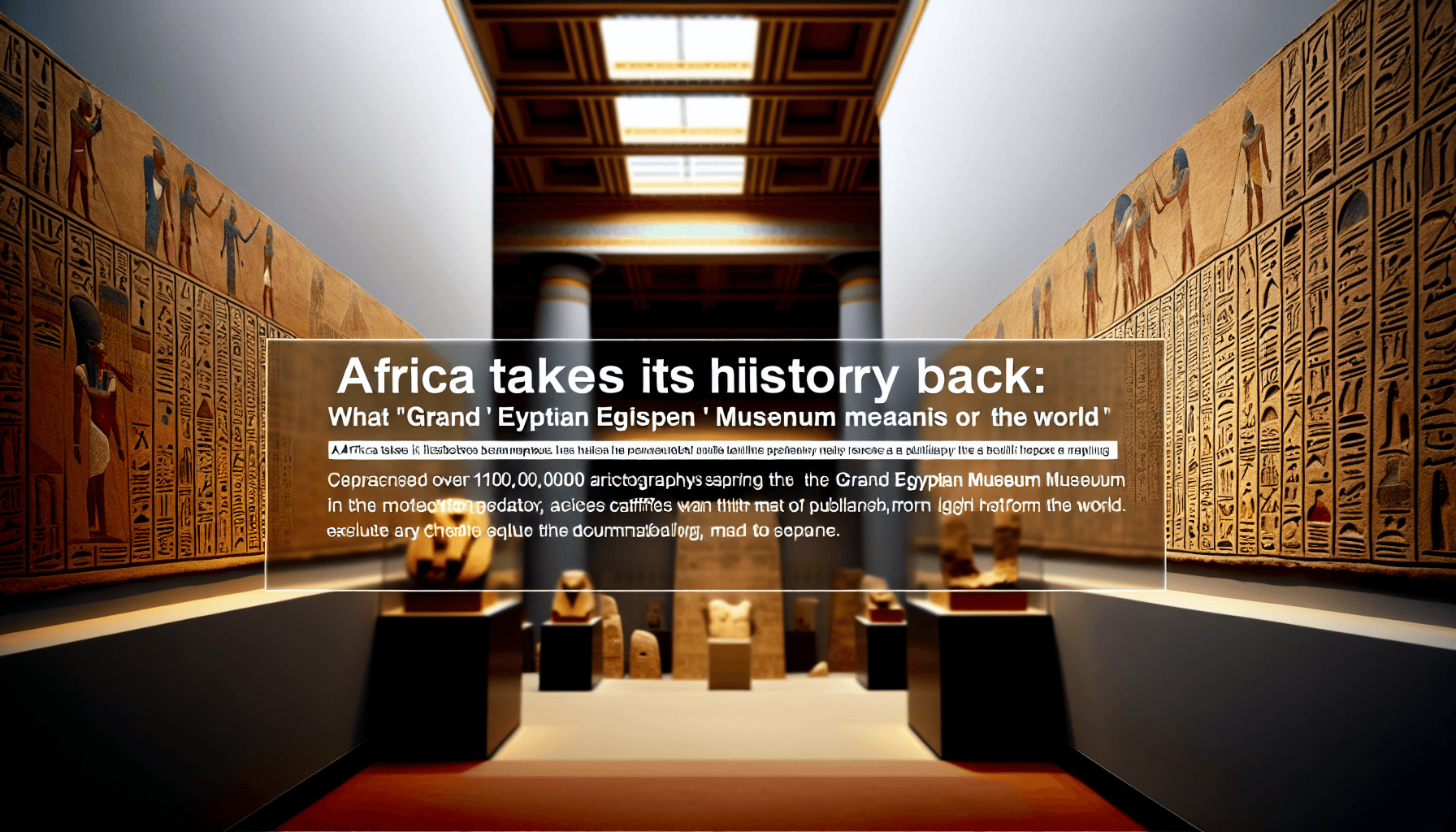
There is a particular kind of power that comes from a civilisation deciding it no longer needs to travel to London, Paris or New York to see itself. Egypt has made that decision. And the world should pay close attention to what it means. The Grand Egyptian Museum - known as the GEM - officially opened its doors in November 2025 on the Giza plateau, a stone’s throw from the Great Pyramids. It is the largest archaeological museum in the world dedicated to a single civilisation. It spans approximately 480,000 square metres - comparable in size to Vatican City. It houses over 100,000 artefacts spanning 7,000 years of Egyptian history, more than half of which are on public display. And at its heart, shown together in their entirety for the first time since British archaeologist Howard Carter discovered the tomb in 1922, is the complete collection of 5,398 objects from the tomb of Tutankhamun - including the iconic 24-kilogram solid gold funeral mask that has become one of the most recognised images in human history. Egypt welcomed 5.6 million tourists in the first quarter of 2026 alone - a 43.5 per cent increase on the same period in 2025 - generating US$5.1 billion in tourism revenue, up from $3.8 billion the previous year. The Egyptian government is targeting 21 million arrivals and $24 billion in tourism revenue by the end of 2026. The GEM is the primary engine driving those numbers. Sources: Nomad Lawyer, ‘Egypt Tourism Record 2026: Q1 Arrivals Surge Past 5 Million,’ 5 May 2026; Egyptian State Information Service. This is not just a tourism story. It is a story about ownership, sovereignty, and the slow, historic correction of a very long injustice.
What Makes This Museum Different
Standing on the Giza plateau with a direct visual line to the Great Pyramids, the GEM is more than a repository for artefacts. It spans over five million square feet, making it the largest archaeological museum in the world dedicated to a single civilisation. TIME magazine recognised it among the World’s Greatest Places for 2026, specifically highlighting the museum’s shift in stewardship - with state-of-the-art climate-controlled galleries, Egypt has created a world-class environment that not only protects its 100,000 artefacts but also strengthens the nation’s position in international discussions regarding the return of displaced antiquities. Source: Egypt Independent, citing TIME’s World’s Greatest Places 2026, 27 March 2026. That last point matters more than any visitor figure. For over a century, Western museums have justified holding Egyptian antiquities by arguing that they could preserve and display them better than Egypt could. That argument is now demonstrably, permanently, and publicly false. The GEM has twelve specialised conservation laboratories. It has climate-controlled galleries purpose-built for ancient artefacts. It has the Tutankhamun collection - every single piece of it - displayed in conditions of extraordinary quality, exactly where it belongs, next to the civilisation that produced it. The new, spacious museum, which cost around a billion dollars, sits outside Cairo in Giza, next to the pyramids and the Sphinx. It bills itself as the largest museum in the world dedicated to a single civilisation, with 5,000 years of history on display. NPR’s correspondent who visited described arriving at ceilings so high the sunlight beams through them, a towering statue of Ramesses II greeting visitors at the entrance, and at the top of the grand staircase, floor-to-ceiling windows framing a direct view of the pyramids outside. The architecture is not incidental. It is a deliberate act of dialogue between the ancient and the modern, designed by the Dublin-based firm Heneghan Peng Architects, whose triangular glass and alabaster facade tilts toward the pyramids in what Monocle described as a silent architectural conversation with the ancient world. Sources: NPR, ‘Egypt’s Grand Museum Opens After Many Delays,’ 26 April 2026; Monocle, ‘Museums Should Ask Questions,’ December 2025.
The Ownership Argument It Makes Without Words
One of the biggest developments in 2026 is GEM’s expanded role as a cultural hub, not just a historical destination. In late January, Art Cairo Fair returned to the museum - weaving contemporary art, education programs and international cultural exchanges into its calendar, positioning the museum as a dynamic destination for both global travellers and regional visitors. Source: Arab America, ‘The Grand Egyptian Museum’s First Full Year,’ January 2026. But the museum’s most significant contribution is diplomatic, not cultural. Egypt has long been fighting to reclaim its antiquities from institutions that acquired them under colonial-era arrangements or outright illegal trafficking. According to the Egyptian Ministry of Tourism’s Antiquities Repatriation Department, Egypt recovered nearly 30,000 illegally smuggled artefacts from abroad between 2011 and 2021. In November 2025, Egypt recovered 36 additional ancient artefacts from the United States - including a mummy mask from the Roman era and 24 Coptic and Syriac manuscripts voluntarily returned by the Metropolitan Museum of Art as a gesture of goodwill. Source: Al-Monitor, ‘Egypt Recovers 36 Ancient Artefacts from US,’ November 2025. The GEM changes the terms of that argument entirely. The standard Western museum defence - that antiquities are safer and better presented in London or Paris - has now been answered with 480,000 square metres of evidence. The museum allows Cairo to reframe the conversation from crisis to civilisation, from IMF loans to the legacy of the pharaohs. It is a spectacle as soft power. That is Monocle’s assessment, and it is accurate. But soft power with a hard edge - because every visitor who stands in that museum and sees Tutankhamun’s golden mask in Giza, with the pyramids visible through the window behind it, will ask themselves a reasonable question: what is the Rosetta Stone still doing in London? Source: Monocle, December 2025.
What This Means for Africa
The significance of the GEM extends well beyond Egypt. It is the most powerful institutional argument Africa has made in decades for the proposition that African civilisations can preserve, present and profit from their own heritage without Western intermediaries. The full opening of the Grand Egyptian Museum has ignited a cultural tourism renaissance across North Africa, creating a seamless travel corridor from the pyramids of Giza to the historic medinas of Marrakech and Tunis. As Cairo and Giza become global anchors for heritage travel in 2026, neighbouring hubs like Algiers and Casablanca are benefiting from increased regional connectivity. Source: Travel and Tour World, ‘Egypt Joins Morocco, Tunisia, Libya and Algeria,’ 2 May 2026. This is African cultural infrastructure creating African economic value - on African terms. That is new. That matters. And it carries a message for every African government that has been told its heritage is better managed elsewhere: it does not have to be. The GEM is not a perfect institution. Monocle raised a fair question about ticket prices that may exclude ordinary Egyptians from the museum that holds their history. The military’s role in construction and early management has been noted by scholars including those writing in Nature. These are legitimate concerns that deserve honest scrutiny. But they do not diminish what has been achieved. A billion-dollar museum. 5.6 million visitors in one quarter. The complete Tutankhamun collection, home for the first time in a century. And a standing, unanswerable argument for the return of what was taken.
The Question the GEM Leaves Hanging
The Rosetta Stone has been in the British Museum since 1802, taken under the terms of a military surrender between British and French generals - neither of whom was Egyptian. It is inscribed in hieroglyphs, Ancient Greek and demotic script. It is one of the most important objects in the history of human language. It was found in Egypt, made in Egypt, and belongs to Egypt. The British Museum has acknowledged receiving repatriation requests but has not confirmed returning a single artefact from its collection. Its standard position is that it holds objects in trust for the world. Egypt has now built the world’s most advanced museum for Egyptian antiquities, next to the pyramids, with twelve conservation laboratories and climate-controlled galleries. The world can come to them. The British Museum’s argument is running out of room.
Sources 1. Nomad Lawyer, ‘Egypt Tourism Record 2026: Q1 Arrivals Surge Past 5 Million with $5 Billion Revenue,’ 5 May 2026 2. Egypt Independent, ‘Grand Egyptian Museum Recognised Among TIME’s 2026 Greatest Places,’ 27 March 2026 3. NPR, ‘Egypt’s Grand Museum Opens After Many Delays,’ Aya Batrawy, 26 April 2026 4. Arab America, ‘The Grand Egyptian Museum’s First Full Year: What 2026 Means for Culture and Tourism,’ January 2026 5. Travel and Tour World, ‘Egypt Joins Morocco, Tunisia, Libya and Algeria,’ 2 May 2026 6. Al-Monitor, ‘Egypt Recovers 36 Ancient Artefacts from US Including Mummy Mask,’ November 2025 7. Monocle, ‘Museums Should Ask Questions: Cairo’s New Grand Egyptian Project,’ December 2025 8. Smithsonian Magazine, ‘Tutankhamun’s Iconic Gold Death Mask Is Getting a New Home,’ June 2025 9. Nature, ‘Egypt Is Building a $1-Billion Mega-Museum. Will It Bring Egyptology Home?’ May 2024 10. Grand Egyptian Museum Official Site, egyptra.pro/grand-egyptian-museum
By Chrispen Nkosi, The Editor
Shared 0 times
Editorial note: This article represents the opinion and analysis of the author and does not constitute verified fact. Ground View News strives for accuracy and publishes corrections when errors are identified. View our editorial policy · Editorial disclaimer