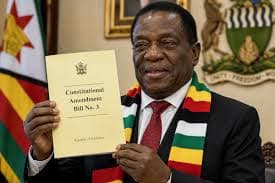
They're Burying the Ballot: How Zimbabwe's Amendment Bill No. 3 Dismantles Democracy From the Inside
Zimbabwe Is Rewriting Its Constitution. The People Were Never Asked.
The Editor, Continental View | Ground View News
16 May 2026
On 16 February 2026, the government of Zimbabwe published a document that could determine who governs the country until 2030 and beyond, and most Zimbabweans found out about it after the fact.
Constitution Amendment Bill No. 3, gazetted that day, proposes extending presidential and parliamentary terms from five to seven years, replacing direct presidential elections with a parliamentary vote, and consolidating executive control over key state institutions. The government has framed these changes as administrative modernisation. Critics call it a constitutional coup.
Both cannot be right.
What the Bill Actually Does
Strip away the official language, and the picture becomes clear. The amendment would extend the terms of office for both the president and parliament from five to seven years, effectively postponing the 2028 elections to 2030. President Emmerson Mnangagwa, constitutionally required to step down in 2028 after two five-year terms, would remain in office for an additional two years under the new arrangement.
The bill also proposes reversing hard-won reforms by restoring responsibility for voter registration and voters' roll compilation to the Registrar-General, and transferring constituency redistricting to a presidentially appointed Zimbabwe Electoral Delimitation Commission. In practical terms, the president would appoint the officials who register voters, compile the roll, and draw the boundaries from which his parliamentary electors emerge. It is a closed loop.
The bill scraps automatic succession by the vice president, replacing it with a parliamentary vote to fill a mid-term presidential vacancy, a provision that critics note serves ZANU-PF's internal succession difficulties more than the Zimbabwean public.
The bill also repeals the Zimbabwe Gender Commission and the National Peace and Reconciliation Commission, transferring their functions to the Zimbabwe Human Rights Commission - two dedicated accountability bodies, dissolved by a stroke of the pen.
A Consultation Process That Was No Consultation At All
The public hearings held in March and April 2026 were widely condemned as a sham designed to manufacture consent rather than gather genuine public opinion. There were numerous reports of violence, physical assaults, and intimidation against citizens who attempted to speak against the bill. Hearings were packed with ruling-party supporters, while opposition voices, including those of a former Finance Minister and a Mayor, were blocked from speaking.
Student leaders affiliated with the Zimbabwe National Students' Union mobilised opposition during nationwide public consultations. ZINASU described the amendment as a "constitutional coup" that weakens democracy and entrenches executive power. On 30 March, ZINASU Secretary General Munashe Dongonda was beaten, and student leader Denford Sithole was forced into a vehicle and taken away.
The Zimbabwe Human Rights Commission released a damning report on the public hearings, and its outspoken chairperson, Jessie Majome, was swiftly reassigned just days afterwards.
This is not a democratic process. This is theatre with consequences.
The Legal Battle and What Comes Next
A Constitutional Court challenge filed by CCC legislator Prince Dubeko Sibanda, seeking to interdict parliament from proceeding with the bill, is pending. Constitutional law expert Justice Mavedzenge has argued that the bill seeks to amend a term limit provision and thereby extend the time a person may hold office, which under section 328(7) of the 2013 Constitution makes a national referendum mandatory, and bars the incumbent from benefiting.
The Attorney General disagrees. But her position is not the final word; the courts are.
Formal legislative processes, including committee review and voting, are scheduled to take place on or after 16 May 2026. It remains technically possible, but highly implausible, that the proposal will be defeated in Parliament. ZANU-PF secured a supermajority in the National Assembly after a series of parliamentary recalls by the main opposition party.
The votes are almost certainly there. That does not make it right.
A Petition Worth Signing
Zimbabweans in the diaspora and at home have begun organising. A Change.org petition calling for the bill to be stopped has been circulating, gathering signatures from those who believe that a constitution belongs to the people, not to the party that currently holds a parliamentary majority.
If you believe that direct presidential elections are a democratic right and not a bureaucratic inconvenience, you can sign the Petition here:
Sign the Petition, Stop Amendment Bill No. 3
Ground View News does not operate this petition and has no affiliation with its organisers. We are sharing it as a matter of public interest. The petition was created independently and is hosted on Change.org.
Sources: ConstitutionNet / International IDEA · Human Rights Watch · JURIST · Newsday Zimbabwe · Bloomsbury Intelligence and Security Institute · The Zimbabwean · Zimbabwe Parliament Gazette
By The Editor, Continental View | Ground View News
Shared 0 times
Editorial note: This article represents the opinion and analysis of the author and does not constitute verified fact. Ground View News strives for accuracy and publishes corrections when errors are identified. View our editorial policy · Editorial disclaimer